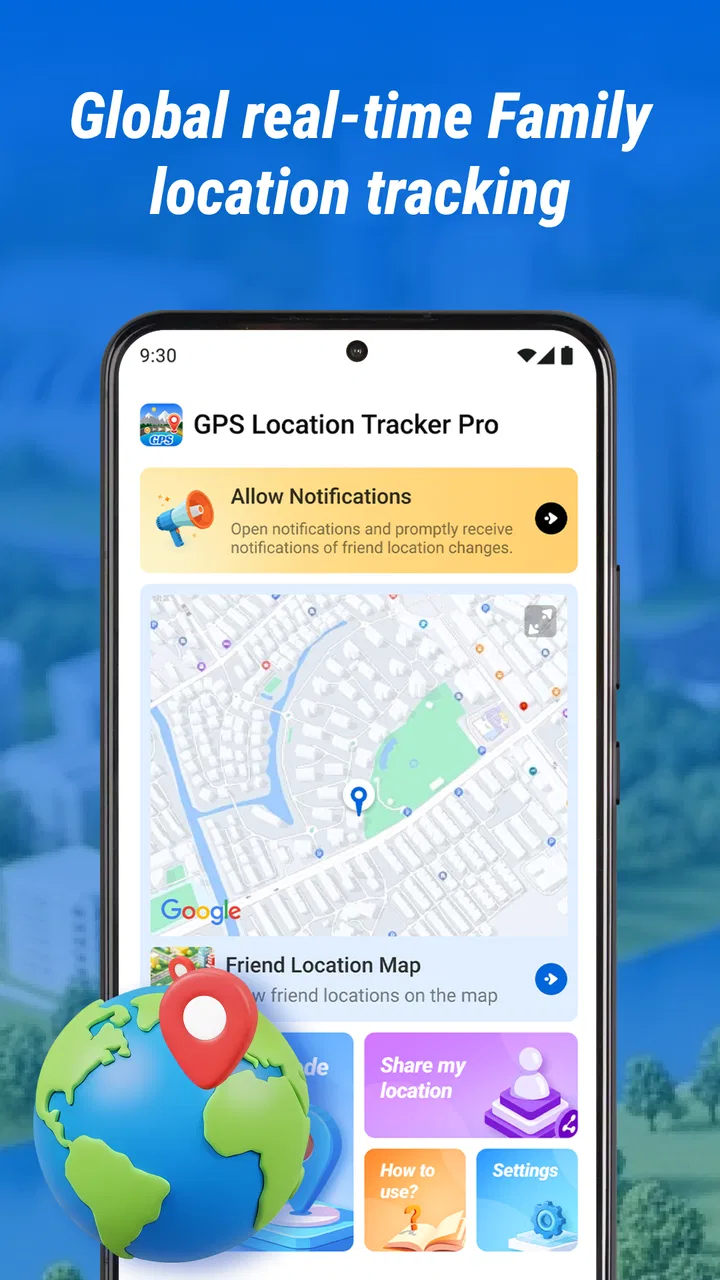
GPS Location Tracker Pro
- 3.5
- Rating
- 5.00M
- Installs
- Free
- Price

 Analysis by App-foxy
I spent time testing GPS Location Tracker Pro as a simple way to keep an eye on the location of friends and family, and my overall impression is that it aims for a very specific kind of convenience: opening a map and checking where important people are instead of sending repeated “Where are you?” messages. It belongs to the Maps & Navigation category, is free to install, and is intended for Everyone. That makes the first step easy for most households, although the real value depends less on the download itself and more on whether the people you want to locate are comfortable using it.
The app is developed by RadoanHossanDev and uses the short store description “GPS Tracker.” That wording is brief, but it points to the central experience rather than presenting the app as a full navigation suite. I would look at it as a focused location-sharing tool, not as a replacement for turn-by-turn driving directions, public transport planning, or a complete travel assistant. If your main need is seeing a friend or relative’s current position, the concept is clear. If you expect a broad collection of mapping tools, the narrower design may feel limiting.
How the free access affects the value
The most important cost detail is straightforward: the app is free. I could consider it without a purchase decision at the download stage, which is useful for families, roommates, or small groups who want to try a location tool before committing to anything. Free access also changes the standard comparison with paid navigation products. You are not paying for a premium map database or a subscription simply to explore the basic idea of location tracking.
You May Also Like

 Blood Strike: 2.5 Anniversary
Blood Strike’s Loadouts Turn Every Drop Into a Tactical Gamble
A close look at Blood Strike’s custom loadouts: how fast access to signature weapons reshapes its battle royale rhythm, rewards preparation, and narrows the gap between fights.

 Pandora - Music & Podcasts
Pandora’s Music Is Easy to Start, but Harder to Recover
Pandora’s strength is its low-effort path from a seed to a station. Its weak spot is how much confidence it asks you to place in connection, setup, and quiet recovery.

 8 Ball Pool
 Is Built on Rivalries, Rematches, and Routine
A close look at the rivalries, rematches, shared routines, and unanswered safety questions that turn a quick pool match into a persistent mobile community.

 Samsung Music
’s Quiet Strength Is Playing What You Already Own
Its reach comes less from spectacle than from dependable access to a personal library. That simplicity is both the app’s strongest retention engine and its ceiling.

 AccuWeather: Weather Radar
AccuWeather Review: A Quick, Clear Forecast for Everyday Decisions
For everyday plans, the best forecast is the one you can understand quickly. AccuWeather makes rain timing, radar, and local conditions easy to act on, with a few trade-offs.

 Hill Climb Racing
Why Hill Climb Racing Still Turns Crashes Into One More Run
A tiny car, a bumpy hill and one more upgrade: Hill Climb Racing keeps resurfacing because its simple chaos makes every near-miss feel personal.
More From Our News Desk
View All News


That does not automatically make it the best value for everyone. A free tracker still has a practical cost in the form of setup time, battery use, mobile data, and the need for cooperation from the people being located. The person checking the map may find the app useful, but the people sharing their location also need to understand how it works and when they are expected to keep it available. In my view, the free price is most meaningful when everyone involved agrees on a clear purpose rather than treating the app as an invisible monitoring tool.
Its public presence is already fairly substantial, with over a million installs and an average rating of 4.0 from around 1.7 thousand ratings. I read those figures as signs that the idea has reached a meaningful audience, not as proof that every phone or household will have the same experience. The app has also accumulated dozens of written reviews, which can help prospective users see how other people react to it, but a rating alone cannot answer the personal questions that matter most: whether your group will share locations reliably, whether the map view is convenient enough, and whether the app fits your privacy expectations.
What the app is actually useful for
The strongest use case is a small circle of people who need occasional reassurance. Imagine a parent waiting for a teenager to arrive after an activity, two friends meeting in an unfamiliar part of town, or relatives coordinating around a busy family event. Instead of asking each person to describe a nearby shop or intersection, the group can use a map-based view to understand where everyone is. That can reduce unnecessary calls, especially when someone is walking, driving, or carrying bags.
I also see value for practical coordination rather than constant observation. A household member could check whether another person has started the journey home before preparing dinner. Friends could use it while traveling separately to the same destination. A caregiver might appreciate a quick way to confirm that a willing family member is moving toward an agreed meeting point. These situations work best when location sharing is discussed in advance and used for a limited, understandable reason.
The useful habit is to treat location sharing as a coordination tool, not a substitute for communication. A map can show where a phone appears to be, but it cannot explain why someone stopped, whether they need help, or whether the displayed position is current enough for a time-sensitive decision. I would still call or message when safety, delays, or confusion are involved.
Practical setup thinking before the first trip
Before relying on it outside the home, I would test the complete workflow with the people who will use it. Have each person open the app, confirm that the intended contacts are involved, and check whether the map view makes sense to everyone. Do this while standing together, then repeat it from separate locations. That simple rehearsal can reveal misunderstandings that are easy to miss when everyone assumes the process is obvious.
A second useful step is agreeing on a communication rule. For example, a family might decide that the app is checked when someone is traveling home, while a group of friends might use it only during a large event. This avoids the expectation that somebody must be visible every minute. It also makes the free app more valuable because the group is using it deliberately instead of leaving it open without a clear benefit.
I would also avoid judging the app from a single indoor test. Location tools can feel different in a room, a crowded street, a parking garage, or an area with weak connectivity. A sensible trial includes the places where you actually expect to use it. If the app is meant for school pickup, test it near the school. If it is for meeting friends downtown, test it around the streets and buildings that normally cause confusion.
Where the simple approach works and where it becomes a tradeoff
The focused nature of GPS Location Tracker Pro is both its appeal and its main limitation. A person who wants one clear purpose may prefer a tracker that does not bury the map under travel planning, route discovery, or unrelated tools. On the other hand, someone who already relies on a familiar map service may find it easier to keep location sharing and navigation in one established ecosystem. The better choice depends on whether separation makes your routine clearer or merely creates another app to maintain.
Compared with ordinary messaging, the advantage is visual context. A text such as “I’m near the station” depends on the sender choosing the right landmark and describing it accurately. A map can make the meeting point easier to understand. The tradeoff is that a message is often more expressive: it can explain a delay, confirm a change of plan, or ask a direct question. I would use the tracker for the “where” and messaging for the “what now?”
Compared with a full navigation application, this app appears better suited to people than routes. If you need detailed directions, traffic guidance, destination search, or broader travel planning, a conventional navigation service is likely the stronger companion. If you only need to see where members of a small group are, a dedicated tracker may feel less distracting. I would not choose this app as my only map tool for a long road trip, but I can see why someone would keep it for family coordination.
Privacy is another tradeoff that should be discussed openly. The app’s purpose involves sharing location, so the person being located should understand who can see them and why. I would never install it on someone else’s phone or pressure a family member into using it without a direct conversation. For children, older relatives, or anyone who may not be comfortable with map technology, setup should be done patiently and with their participation. A free app is not a reason to lower the standard for consent.
Questions I would answer before depending on it
One question is whether it is suitable for emergency response. I would not make that assumption. A location tracker can support everyday coordination, but an emergency should be handled through the appropriate emergency services and direct contact. If someone is missing, injured, or in immediate danger, checking a map is not enough and may not be current or precise enough for the situation.
Another question is whether it replaces a phone call. In my experience, it does not. Seeing a person’s position may tell you that they are still traveling, but it will not tell you if they are lost, have changed plans, or cannot safely respond. I would use the map to decide whether a call is necessary, not to avoid communication altogether.
People also reasonably wonder whether the app is good for continuous supervision. I think that is the wrong mindset. Its value is clearer for agreed periods and specific situations: a journey, a meetup, a family outing, or a pickup window. Continuous checking can create anxiety and conflict, particularly when map updates do not match someone’s expectations. Setting boundaries before use is more important than checking the screen repeatedly.
A further question is whether the app will suit a mixed group of users. That depends on how willing everyone is to install and use the same tool. A location app only helps when the relevant people participate. If some friends or relatives refuse to join, an existing messaging or map service that they already understand may be more practical, even if it is less focused.
Small workflows that make the free app more worthwhile
For a family outing, I would create a simple routine: everyone checks the map before leaving, agrees on one meeting area, and uses a message if plans change. This prevents the tracker from becoming a constant source of questions. It also helps when a group separates temporarily, because the map gives everyone a shared reference point without requiring a long explanation.
For friends meeting in a crowded place, I would use the app before entering the busiest area. Once people are close, a precise landmark or short message may still be faster than watching the map. This is a useful tradeoff: the tracker reduces the uncertainty of the approach, while ordinary conversation finishes the meeting process.
For relatives who are less confident with smartphones, I would keep instructions minimal and repeatable. Show them how to open the app, identify the people they recognize, and contact someone if the situation changes. Do not assume that a map marker automatically communicates everything. A brief practice session is likely to be more valuable than giving them a long technical explanation.
For a shared household, I would decide when location checking is appropriate and when it is not. That boundary protects trust and keeps the app from turning into a background source of suspicion. In this context, the app’s greatest strength is not simply the map; it is the possibility of replacing repetitive status questions with an agreed, limited workflow.
Who should choose it, and who should skip it
I would recommend trying it to people who want a free, focused way to view the location of friends or family and who can get the whole group to participate. It is especially appealing if your current method is a stream of vague messages, missed calls, and descriptions of nearby landmarks. The app may also suit users who prefer keeping location coordination separate from their main navigation application.
I would be more cautious for anyone who needs professional-grade navigation, detailed route planning, or a single app that handles every travel task. A dedicated map and navigation service will usually be a better fit for those needs. I would also skip it if the people you want to locate are unwilling to share their positions, because no interface can solve a participation problem.
It may not be the right choice for someone who expects location information to be perfectly live, universally precise, or suitable for emergencies. Those expectations can lead to frustration and unsafe decisions. The sensible approach is to test it in your regular environments, agree on boundaries, and keep another communication method available.
The current release is version 2.0.0.0 and supports devices running Android 7.0 or later. That gives it a broad compatibility range for many Android users, although compatibility alone does not guarantee that every device will behave identically. I would install it on the phones that will actually be used, complete a short trial, and decide based on the group’s real routine rather than on the store rating alone.
My final verdict is positive but deliberately limited. GPS Location Tracker Pro offers a free entry point into a straightforward location-sharing workflow, and its focus can be useful when friends or relatives need to coordinate without constant status messages. I like it most for planned, consent-based situations where everyone understands what the map is for. I would skip it as a replacement for emergency services, full navigation, or honest communication.
For the right household or friend group, there is little financial risk in trying it, and the practical benefit can be noticeable when meeting up or checking a journey. The real question is not whether the app can display a location; it is whether your group can use that information respectfully and consistently. If the answer is yes, this free Maps & Navigation app from RadoanHossanDev is worth testing. If not, a familiar messaging or map service may be the better choice, even if it offers a broader and less focused experience.
FAQs for GPS Location Tracker Pro
01What features does GPS Location Tracker Pro offer?
GPS Location Tracker Pro provides real-time tracking, route history, and geofencing capabilities. Users can monitor multiple devices simultaneously and receive notifications for arrival and departure updates. Additionally, the app supports offline maps, making it convenient for use in areas with limited internet connectivity.
02Is my personal data secure with GPS Location Tracker Pro?
Yes, GPS Location Tracker Pro prioritizes user privacy and employs advanced encryption protocols to protect personal data. The app requires minimal permissions and does not share your location information with third parties. Users can also customize privacy settings to control who can see their location.
03Can GPS Location Tracker Pro be used internationally?
Absolutely. GPS Location Tracker Pro supports international tracking, allowing users to monitor devices across different countries. The app uses global positioning systems to ensure accurate tracking, regardless of the user's location. However, international data charges may apply, depending on your mobile provider.
04Does GPS Location Tracker Pro drain phone battery quickly?
While continuous GPS tracking can impact battery life, GPS Location Tracker Pro is optimized for efficiency. The app includes power-saving modes and allows users to adjust tracking intervals to balance accuracy and battery consumption. It's recommended to keep your device charged during extended use.
05Is GPS Location Tracker Pro compatible with both Android and iOS devices?
Yes, GPS Location Tracker Pro is available for both Android and iOS platforms. The app offers a seamless user experience across devices, with regular updates to ensure compatibility with the latest operating system versions. Users can download it from the Google Play Store or the Apple App Store.
Pros
- Accurate real-time location tracking.
- User-friendly interface and navigation.
- Low battery consumption.
- Customizable alerts and notifications.
- Works offline with preloaded maps.
Cons
- Requires constant internet connection.
- Limited features in the free version.
- Occasional GPS signal loss.
- Privacy concerns with data sharing.
- Ads in the free version can be intrusive.

GPS Location Tracker Pro
Gallery